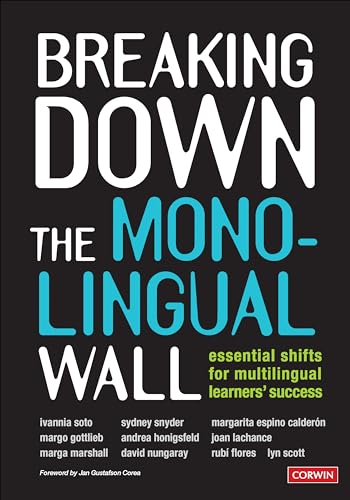
Breaking down the monolingual wall : essential shifts for multilingual learners' success / Ivannia Soto, [and 9 others].
Material type: TextPublisher: Thousand Oaks, California : Corwin, 2023Description: xxiv, 278 pages ; 26 cmContent type:
- text
- unmediated
- volume
- 9781071895535
- 23 370.117 So781b
- LC3715 .S67 2024
| Item type | Current library | Shelving location | Call number | Copy number | Status | Date due | Barcode | |
|---|---|---|---|---|---|---|---|---|
 Books |
Main Library | Circulation Section | CIR 370.117 So781b 2024 (Browse shelf(Opens below)) | 1-1 | Available | 032664 |
Includes bibliographical references and index.
From subtractive schooling models to dual language models that lead to linguistic and cultural equity -- From culturally and linguistically subtractive to culturally and linguistically sustaining pedagogy -- From one language to biliteracy and content in two languages -- From one language to biliteracy and content in two languages -- From monolingual assessment to assessment in multiple languages -- From educator collaboration in a monolingual setting to collaboration in a dual language setting -- From leading in a monolingual program to leading in a dual language program -- From "one-size-fits-all" workshops to job embedded professional learning for dual language teachers -- From monolingual policies to dual language policies.
"The evidence is clear and compelling: multilingualism is good for kids, adults, and enhancing our quality of life in a global society. Moreover, multilingual proficiency is associated with greater cognitive flexibility, better problem-solving abilities, a superior working memory, a stronger grasp of abstract concepts, greater social/cultural awareness, and increased self-regulation over language and academic success. For far too long, dual-language instruction has been a privilege afforded to affluent families. For example, parents who can afford the tuition may opt to enroll their children in private Lycees Francais. Yet, the very children who stand to benefit the most from teaching and learning in two languages -- our nation's English learners -- often don't have access to such programs. For more than two decades, the state of California effectively banned any form of bilingual education under Proposition 227. Fortunately, recent policy shifts in California and other "English-only" states have spurred demand for more dual language programs and bilingual educators. California, in particular, has made efforts to increase its bilingual teacher pipeline to meet the growing demand. By valuing and advancing multilingualism as a principle of social justice, communities and schools can join forces to ensure that multilingual children have equitable opportunities to learn and thrive"-- Provided by publisher.
There are no comments on this title.