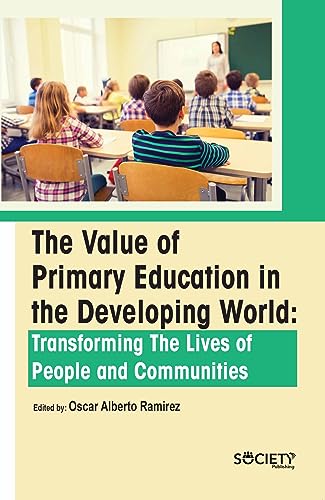
The value of primary education in the developing world : transforming the lives of people and communities / edited by Oscar Alberto Ramirez.
Material type: TextPublisher: Burlington, Ontario : Society Publishing, 2023Description: xv, 228 pages : illustrations ; 24 cmContent type:
- text
- unmediated
- volume
- 9781774694657
- 370.117 V249
| Item type | Current library | Shelving location | Call number | Copy number | Status | Date due | Barcode | |
|---|---|---|---|---|---|---|---|---|
 Books |
Main Library | Circulation Section | CIR 370.117 V249 2023 (Browse shelf(Opens below)) | 1-1 | Available | 031016 |
Browsing Main Library shelves, Shelving location: Circulation Section Close shelf browser (Hides shelf browser)

|

|

|

|

|

|

|
||
| CIR 370.117 N558l 2018 Language, culture, and teaching : critical perspectives / | CIR 370.117 So781b 2024 Breaking down the monolingual wall : essential shifts for multilingual learners' success / | CIR 370.117 T220 2014 Teaching and learning in multilingual contexts : sociolinguistic and educational perspectives/ | CIR 370.117 V249 2023 The value of primary education in the developing world : transforming the lives of people and communities / | CIR 370.117094 M919 2020 Multilingual approaches for teaching and learning : from acknowledging to capitalising on multilingualism in European mainstream education / | CIR 370.1170973 P193d 2018 Diversity & equity in the classroom | CIR 370.1175 Au72s 2022 School-wide systems for multilingual learner success : a roadmap for leaders / |
Includes bibliographical references and index.
Introduction to primary education -- Finding purpose in primary education -- Contemporary perspectives on primary education -- New horizons for primary education -- Key learning priorities for primary education -- Philosophical debates and approaches to primary education -- Innovation in primary education -- The future of primary education -- Concluding remarks.
"Many people that operate in the world of development economics and sustainable development have concluded that education is the key to success. This is evidenced by several studies indicating the positive relationship between education and prosperity as well as well-being in many instances. Given the limited funds that may be available for education, some countries have focused on primary education as a starting point. The alternative of higher education may have elitist connotations that are not normatively acceptable. The rationale is that if you get children when they are still young, you have the chance to give them the skills and confidence to explore the world later in life. There is a particular focus on primary education because it is thought to be a relatively easy option when compared to other approaches such as focusing on secondary or tertiary education. Moreover, there is an implicit assumption that primary education brings significant results to the table in terms of improving human welfare. It is for this reason that universal primary education has become a mantra and a goal for all those who are interested in lifting many countries out of poverty. The education sector is generally receiving a lot of attention from policy makers. However, the primary level of education is of particular interest. Primary education is going to be the key to sustainable development. Therefore, it must be understood and contextualized depending on the different people that access this type of social service. The education that is provided to children must be meaningful and relevant to their context. At the same time, education must prepare young people for competitiveness on the global stage where there is a high unemployment rate and the increasing threats of technology which will takeaway many of the jobs that were traditionally available to young people. Countries that are looking for prosperity will have to invest in primary education. However, that investment must be informed by experiences from those that have implemented universal and piecemeal education systems. Education must have a purpose. For example, some communities are using education to deal with such community dysfunction and address long-standing problems such as gender inequality. In the West and Global North, this education has tackled issues such as racism and xenophobia. The rationale is that someone who is educated is less likely to engage in destructive behavior. Of course, there are critics of the current education system who might argue that education makes things worse. For example, an education system that is steeped in colonial over tones and undertones is unlikely to empower people in the developing world. Similarly, an education that is devoid o skills is not going to satisfy the needs of the world today. This book explores the value and limitations of primary education. It is intended for undergraduates that have an interest in issues of education regardless of their specialization. Therefore, this book is written from an eclectic, multidisciplinary, and interdisciplinary perspective. After all, that is the nature of education regards of whether it is primary or comes in other forms. I hope you enjoy reading the book and learn something from it." -- Back cover
There are no comments on this title.