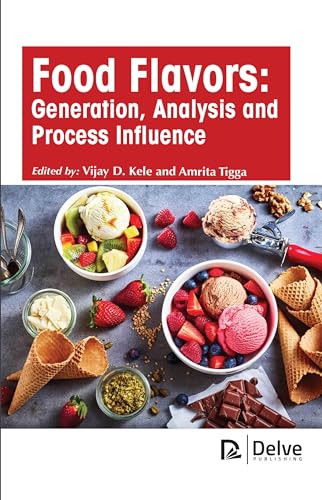
Food flavors : generation, analysis and process influence / edited by Vijay D. Kele and Amrita Tigga.
Material type: TextPublisher: Burlington, Ontario : Delve Publishing, 2022Description: xvii, 234 pages : illustrations ; 24 cmContent type:
- text
- unmediated
- 9781774690321
- 664.07 F739 23
- TP372.5 .F663 2022
| Item type | Current library | Shelving location | Call number | Copy number | Status | Date due | Barcode | |
|---|---|---|---|---|---|---|---|---|
 Books |
Main Library | Graduate School Library | GRD 664.07 F739 2022 (Browse shelf(Opens below)) | 1-1 | Available | 032138 |
Includes bibliographical references and index.
Introduction to food flavors -- Natural food flavors -- Analysis of food flavors -- Aroma of fruits and vegetables -- Aroma of meat products -- Autoxidation and flavors -- Flavors in nutraceutical foods -- Process influence -- Nanotechnology for food flavors -- Advances in food flavor technology -- Problems with food flavors.
"Flavor can be considered as one of the important sensory attributes that can attract several customers. The accept ability of foods will be based on the flavors. This importance has led to devise new methods to enhance food flavors. Most of the food scientists and nutritionists have worked on preparing food flavors that can be healthier for the customers. This is a challenging task and a lot of expertise is needed to bring about the methodology in the production of flavour-based foods. Many nutritional properties are to be considered whilst processing the foods. There are many coloring and flavoring agents that have been developed by industries and some of the flavoring agents are natural and pose a limited threat to humans. Natural flavors can be used to enhance the value of the food products in the market. Recent developments in organic agriculture have increased the use of flavors extracted from plants. Chemical engineering and computer-aided techniques have brought the best products in a limited time.
The analysis of flavors is a laborious task and it needs sophisticated instruments. The accuracy of the instruments that are being used in analyzing flavors is considered an essential factor. The process influence and the packaging technology play a vital role in the case of packed foods. The loss of flavor is often a challenging task in the supply chain of food products. The microscopic techniques, high-performance liquid chromatography, and mass spectroscopy are classified as important instruments that can be used in the analyses of food products. This book provides information pertaining to the quality of food products and their flavor generation. The flavor dynamics that are being lost in the processing stage are explained.
This book comprises chapters that cover aromas, analyses of flavors. The tools needed for the analyses of the flavors are explained in this book. This book can be used as an essential handbook for students pursuing food Science and technology courses"-- Back cover.
There are no comments on this title.