
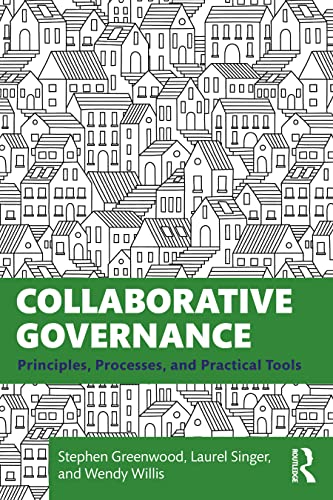
Collaborative governance : principles, processes, and practical tools / Steven Greenwood, Laurel Singer, and Wendy Willis.
Material type: TextPublisher: New York, NY ; Abingdon, Oxon : Routledge, 2021Description: x, 213 pages : illustrations ; 23 cmContent type:
 - text
- unmediated
- volume
- 9780367776015
- 320.6 G856c 23
- JF1525.P6 G75 2021
| Item type | Current library | Shelving location | Call number | Copy number | Status | Date due | Barcode | |
|---|---|---|---|---|---|---|---|---|
 Books
Books
|
Main Library | Graduate School Library | GRD 320.6 G856c 2021 (Browse shelf(Opens below)) | 1-1 | Available | 030112 |
Includes bibliographical references and index.
Introduction -- Section 1. Definitions, context, and dynamics -- Definitions and descriptions -- Collaborative governance in a constitutional context -- Typologies -- Fundamental dynamics of collaboration -- Section 2. Framework and process -- Assessment -- Design and organization -- Deliberation and decision-making -- Implementation and adaptation -- Section 3. Skills to improve collaborative governance -- Strengthening collaborative governance groups -- Individual leadership tools.
"Traditional governance, even when it is functioning effectively and fairly, often produces clear winners and clear losers, leaving smoldering resentments that flare up whenever there is a shift in the balance of power. Over the past two and a half decades, a new style of governance has arisen to disrupt some of that winner-takes-all dynamic, offering parties a means to collectively navigate their interests in a highly focused and democratic way. Collaborative Governance is the first true textbook on the topic, presenting a solid grounding in relevant theory while also focusing on case studies, process design, and practical tools. While existing books on collaborate governance focus on environmental and natural resource conflict resolution, this book also draws on case studies involving collaborative, community-based project implementation and cases that focus on human services and social equity. Bringing together theory and tools from the fields of negotiation and mediation, as well as political science and public administration, this book introduces students and practitioners to the theory of collaborative governance in the context of practical applications. Coverage includes: A connection of the practices of collaborative governance with the field's theoretical underpinnings Tools for students and practitioners of collaborative governance-as well as public administrators and other possible participants in collaborative governance processes-to discern when collaborative governance is appropriate in politically complex, real-world settings A roadmap for students, practitioners, and process participants to help them design-and effectively participate in-productive, efficient, and fair collaborative governance processes An exploration of constitutional democracy and the ways in which collaborative governance can be used as a tool in building a more just, fair, and functional society. Collaborative Governance is an ideal primary textbook in public administration, planning, and political science courses, as well as a jargon-free primer for professionals looking to learn more about the theory and practice of this important field"-- Provided by publisher.
There are no comments on this title.