
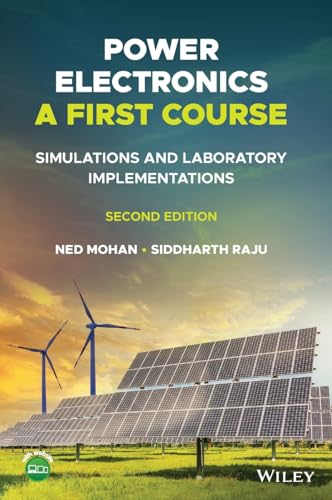
Power electronics, a first course : simulations and laboratory implementations / Ned Mohan and Siddharth Raju.
Material type: TextPublisher: Hoboken, New Jersey : John Wiley & Sons, Inc., 2023Edition: Second editionDescription: xix, 327 pages : illustrations ; 26 cmContent type:
 - text
- unmediated
- volume
- 9781119818564
- 621.31 M725p 23/eng/20221017
- TK1001 .M5985 2023
| Item type | Current library | Shelving location | Call number | Copy number | Status | Date due | Barcode | |
|---|---|---|---|---|---|---|---|---|
 Books
Books
|
Main Library | Engineering Section | ENG 621.31 M725p 2023 (Browse shelf(Opens below)) | 1-1 | Available | 029140 |
Includes bibliographical references and index.
Power electronics: an enabling technology -- Design of switching power-poles -- Switch-mode DC-DC converters: switching analysis, topology selection, and design -- Designing feedback controllers in switch-mode DC power supplies -- Rectification of utility input using diode rectifiers -- Power-factor-correction (PFC) circuits and designing the feedback controller -- Magnetic circuit concepts -- Switch-mode DC power supplies -- Design of high-frequency inductors and transformers -- Soft-switching in DC-DC converters and half-bridge resonant converters -- Applications of switch-mode power electronics in motor drives, uninterruptible power supplies, and power systems -- Synthesis of DC and low-frequency sinusoidal AC voltages for motor drives, UPS and power systems applications -- Thyristor converters -- Utility applications of power electronics.
"Role of Power Electronics in Providing Sustainable Electric Energy As discussed in the introductory chapter of this textbook, power electronics is an enabling technology for powering information technology and making factory automation feasible. In addition, power electronics has a crucial role to play in providing sustainable electric energy. Most scientists now believe that carbon-based fuels for energy production con- tribute to climate change, which is a serious threat facing human civilization. In the United States, the Department of Energy reports that approximately 40% of all the energy consumed is first converted into electricity. Potentially, use of electric and plug-in hybrid cars, high speed rails, and so on may increase this to even 60%. Therefore, it is essential that we generate electricity from renewable sources such as wind and solar, which at present represent only slightly over 4%, build the next-generation smarter and robust grid to utilize renewable resources often in remote locations, and use electricity in more energy-efficient ways. Undoubtedly, using electricity efficiently and generating it from renewable sources are the twin pillars of sustainability, and as described in this textbook, power electronic systems are a key to them both! This textbook focuses on Power Electronic Systems as one of the topics in an integrated Electric Energy Systems curriculum consisting of Power Electronics, Power Systems and Electric Machines and Drives. This textbook follows a top-down systems- level approach to Power Electronics to highlight interrelationships between these sub- fields within this curriculum, and is intended to cover both the fundamentals and practical design in a single-semester course. This textbook follows a building-block approach to power electronics that allows an in-depth discussion of several important topics that are left out in a conventional course, for example, designing feedback control, power-factor-correction circuits, soft- switching, and Space-Vector PWM, which is a PWM technique, far superior to Sine- PWM, to name a few. Topics in this book are carefully sequenced to maintain continuity and student interest throughout the course. In a fast-paced course with proper student background, this book can be covered from front-to-back in one semester. However, the material is arranged in such a way that an instructor, to accommodate the students' background, can either omit an entire topic or cover it quickly to provide just an overview using the accompanying slides, without interrupting the flow"-- Provided by publisher.
There are no comments on this title.