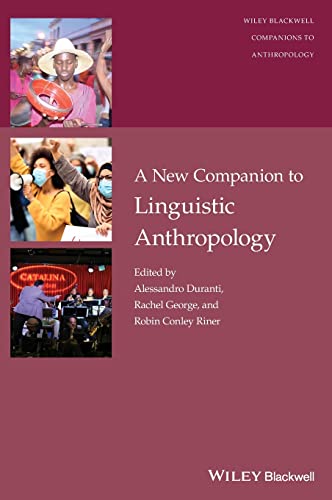
A new companion to linguistic anthropology / edited by Alessandro Duranti, Rachel George, and Robin Conley Riner.
Material type: TextSeries: Wiley Blackwell companions to anthropologyPublisher: Hoboken, New Jersey : Wiley-Blackwell, 2023Description: xvii, 622 pages : illustrations ; 27 cmContent type:
- text
- unmediated
- volume
- 9781119780656
- 306.44 N420 23/eng/20221107
- P35 .N49 2023
| Item type | Current library | Shelving location | Call number | Copy number | Status | Date due | Barcode | |
|---|---|---|---|---|---|---|---|---|
 Books |
Main Library | Circulation Section | CIR 306.44 N420 2023 (Browse shelf(Opens below)) | 1-1 | Available | 032718 |
Includes bibliographical references and index.
Introduction -- Part I: Speech communities and their contested boundaries -- On the social lives of indigenous North American languages -- Creolization: its context, power, and meaning -- Language endangerment and renewal -- Narrating transborder communities -- Mixing, switching, and languaging in interaction -- Postcolonial semiotics -- Deaf communities: constellations, entanglements, and defying classifications -- Global hip hop: style, language, and globalization -- Part II: Literacies and textualities across time and space -- Ancient literacy practices and script communities -- Rethinking translation and transduction -- Social dramas: a semiotic approach -- Digital literacies -- Digital religious discourse -- Linguistic anthropology of the visual -- Technobodily literacy in video interaction -- Ethics and language -- Part III: Speaking, sensing, and sounding -- Contested intentions -- Entanglements of language and experience in everyday life -- Affect, emotion, and linguistic shift -- Using the senses in animal communication -- Human touch -- Socialization of attention -- Sound, voice, and the felt body -- Multimodality -- Language and food -- Part IV: Language, power, and justice -- Language policy and ethnic conflict -- Secrecy -- Legal language and its ideologies -- Language, gender, race, and sexuality: intersectional perspectives -- Engaged linguistic anthropology -- Language and racism -- Communicative justice and health -- The force of indexicality.
"The original Companion to Linguistic Anthropology was published in 2004. The New Companion, whose all-new chapters aim to capture the state of the discipline in the first two decades of the twenty-first century, illustrates the many exciting new directions in linguistic anthropology as well as the persistence, elaboration, and transformation of some of the foundational concepts discussed in the 2004 volume. The major sections in the new volume showcase how the subfield has reworked classic linguistic anthropological concepts and methods and developed new ones in response to political, social, and technological developments over the last several decades, including 1) renewing commitments to engaged linguistic anthropology in a time of ongoing political and environmental crises 2) continuing to both critique and assert the relevance of community and its multiple variants as a unit of analysis 3) tracing the temporal and spatial contours of interaction in a globalized, mediatized world and 4) emphasizing the role of the senses and experience in language. In the introduction, we explore each of these developments in turn, revealing ways they influence each other and how they have shaped thematic developments in the field, including the rise to prominence of topics such as chronotope and scale, materiality, language and experience, decolonization, and posthumanism. The discussion focuses on the ways in which: 1. linguistic anthropologists have recommitted themselves to social justice issues and responded directly to political and historical events and crises of the first two decades of the 21st century 2. the resulting new thematic directions in linguistic anthropology have both transformed and reaffirmed the field's classic topics of study, methods, and theoretical underpinnings 3. such developments enable new forms of interdisciplinarity both within and beyond anthropology and allow us to (re)consider both the place of language and the taken-for-granted centrality of humans in our research"-- Provided by publisher.
There are no comments on this title.