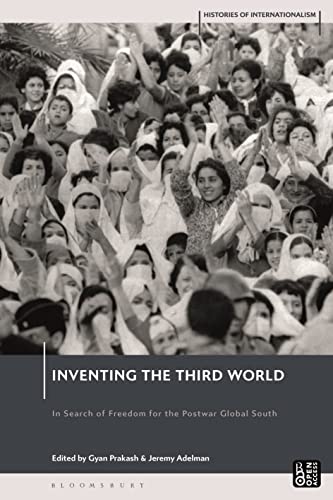
Inventing the third world : in search of freedom for the postwar global South / edited by Gyan Prakash and Jeremy Adelman.
Material type: TextSeries: Histories of internationalismPublisher: London ; New York : Bloomsbury Academic, 2023Description: ix, 279 pages ; 24 cmContent type:
- text
- unmediated
- volume
- 9781350268159
- Developing countries -- Economic conditions
- Developing countries -- Foreign relations
- Developing countries -- International status
- Developing countries -- Politics and government
- Postcolonialism -- Developing countries
- World politics -- 1945-
- Cultural diplomacy -- Developing countries -- History -- 20th century
- 327.1091724 In895 23
- D887 I58 2023
| Item type | Current library | Shelving location | Call number | Copy number | Status | Date due | Barcode | |
|---|---|---|---|---|---|---|---|---|
 Books |
Main Library | Circulation Section | CIR 327.1091724 In895 2023 (Browse shelf(Opens below)) | 1-1 | Available | 032730 |
Includes index.
Introduction: Imagining the third world: genealogies of alternative global histories -- The third world before Afro-Asia -- From peace to national liberation: Mexico and the tricontinental -- A voice for the Yugoslavs in Latin America: Oscar Waiss and the Yugoslav-Chilean connection -- The end of ideology and the third world: the congress for cultural freedom's 1955 Milan conference on the 'future of freedom' and its aftermath -- Latin American network in exile: a communist cultural legacy for the third world -- Radical scholarship and political activism: Walter Rodney as third world intellectual and historian of the third world -- From London 1948 to Dakar 1966: crises in anticolonial counterpublics -- Francis Newton Souza's black paintings: postwar transactions in color -- Listening to the cold war in Bombay -- Imagining a progressive world: soviet visual culture in postcolonial India -- The battle of conferences: cultural decolonisation and global cold war -- The death of the third world revisited: curative democracy and world-making in late 1970s India.
""This book is available as open access through the Bloomsbury Open Access programme and is available on www.bloomsburycollections.com. It is funded by Princeton University, USA. The end of the Second World War and the eclipse of empires brought a wave of efforts to reimagine the future world order. When nation states emerging from colonial rule met at Bandung to chart alternative destinies and challenge global inequalities, they hoped to create a less hierarchical, more pluralistic and more distributive world. This volume considers the alternative visions put forth by the third world at the close of WWII to recover their world-changing aspirations as well as its cultural and intellectual breakthroughs. Demonstrating how the invention of the third world sought to create new institutions of solidarity, new expressions and alternative narratives to the imperial ones that they had inherited, this book reveals how writers, artists, musicians and photographers created networks to circulate and exchange these ideas. Exploring these ideas put forth from various regions of the global south, the chapters trace their search for new meanings of freedom, self-determination and the promise of development. Out of this moment came efforts in the south to create new histories of global relations, icons and genres, and placed the promises of decolonization and struggles for social and racial justice at the centre of global history. Showing how efforts to remake the world intersected with and altered the trajectories of the global Cold War, Inventing the Third World discusses how this conflict existed outside of the traditional east-west framework and offers an insight into a radically different 'global cultural cold war'. It shows that the Cold War era was marked by attempts to bring about a different world order that would achieve global racial, social justice and a different kind of peace"-- Provided by publisher.
There are no comments on this title.