
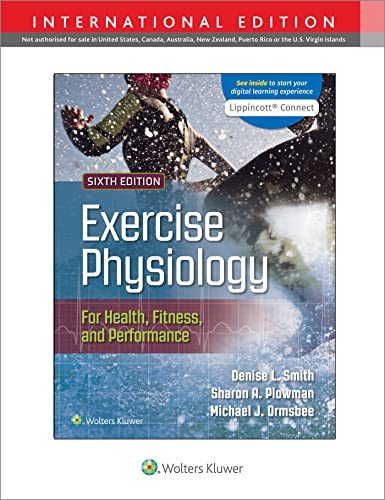
Exercise physiology for health, fitness, and performance / Denise L. Smith, Sharon A. Plowman, and Michael J. Ormsbee.
Material type: TextPublisher: Philadelphia, Pennsylvania : Wolters Kluwer, 2023Edition: Sixth editionDescription: xxii, 818 pages : illustrations ; 28 cmContent type:
 - text
- unmediated
- volume
- 9781975179625
- 23 612.044 Sm511e
- QP301 .S658 2023
| Item type | Current library | Shelving location | Call number | Copy number | Status | Date due | Barcode | |
|---|---|---|---|---|---|---|---|---|
 Books
Books
|
Main Library | Circulation Section | CIR 612.044 Sm511e 2023 (Browse shelf(Opens below)) | 1-1 | Available | 031270 |
Includes index.
The warm-Up -- Metabolic system unit -- Energy production -- Anaerobic metabolism during exercise -- Aerobic metabolism during exercise -- Metabolic training principles and adaptations -- Nutrition for fitness and athletics -- Body composition: determination and importance -- Body composition and weight control -- Cardiovascular-respiratory system unit -- Respiration -- Respiratory exercise response, training adaptations, and special considerations -- The cardiovascular system -- Cardiovascular responses to exercise -- Cardiorespiratory training principles and adaptations -- Thermoregulation -- Cardiovascular disease risk factors and physical activity -- Neuromuscular-skeletal system unit -- Skeletal system -- Skeletal muscle system -- Muscular contraction and movement -- Muscular training principles and adaptations -- Neuromuscular aspects of movement -- Neuroendocrine-immune system unit -- Neuroendocrine control of exercise -- The Immune system, exercise, training, and illness.
"With this new 6th Edition, Exercise Physiology for Health, Fitness, and Performance continues to provide an authoritative resource for mastering exercise physiology. This engaging, accessible and approachable resource integrates theoretical and research-based basic exercise physiology with real-world application to prepare students for exciting positions in exercise science, fitness, physical education, athletic training, rehabilitation, coaching, and/or allied health professions. Updated throughout, the text uses sound pedagogical principles to explain scientific research that is the foundation of exercise physiology and incorporates multiple features to help students apply their knowledge to improve human health, fitness, and performance. Content in this edition is organized by independent units (Metabolic, Cardiovascular-Respiratory, Neuromuscular-Skeletal, and Neuroendocrine-Immune), offering maximum teaching flexibility for faculty and ensuring a consistent, efficient, and effective learning experience for students. - New Literature Search exercises reinforce the scientific basis of each discipline and boost students information literacy. - Current research incorporated throughout the text keeps students up to date with emerging topics and the latest approaches to exercise physiology. - Focus on Application and Focus on Research boxes strengthen students ability to recognize the impact of research on practice and apply basic concepts to relevant scenarios. - Clinically Relevant boxes familiarize students with information, situations, or case studies they may encounter during internships or professional practice. - Check Your Comprehension boxes reinforce the ability to work through problems, interpret circumstances, analyze information, and deduce answers as you move through each chapter. - Example boxes enhance problem-solving and calculation skills. - Definition boxes help students master key terminology. - Summaries highlight essential chapter takeaways at a glance. - Links to Online Resources help students make the most of their study time and ensure understanding"-- Provided by publisher.
There are no comments on this title.