
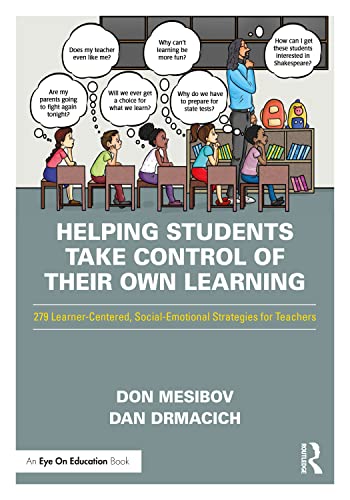
Helping students take control of their own learning : 279 learner-centered social-emotional strategies for teachers / Don Mesibov and Dan Drmacich.
Material type: TextSeries: Routledge eye on educationPublisher: New York, NY ; Abingdon, Oxon : Routledge, 2022Description: xxii, 249 pages : illustrations ; 25 cmContent type:
 - text
- unmediated
- volume
- 9781032246635
- 371.394 M561h 23/eng/20220209
- LB1027.23 .M46 2022
| Item type | Current library | Shelving location | Call number | Copy number | Status | Date due | Barcode | |
|---|---|---|---|---|---|---|---|---|
 Books
Books
|
Main Library | Circulation Section | CIR 371.394 M561h 2022 (Browse shelf(Opens below)) | 1-1 | Available | 030378 |
Browsing Main Library shelves, Shelving location: Circulation Section Close shelf browser (Hides shelf browser)

|

|

|

|

|

|

|
||
| CIR 371.39 M289 2019 Makers, crafters, educators : working for cultural change / | CIR 371.393 Ob62l 2020 Leading better behaviour : a guide for school leaders / | CIR 371.394 Ad171t 2019 Teaching through peer interaction / | CIR 371.394 M561h 2022 Helping students take control of their own learning : 279 learner-centered social-emotional strategies for teachers / | CIR 371.395 G918 2016 Group works in schools | CIR 371.397 D758m 2023 Modeling and simulation in python : an introduction for scientists and engineers / | CIR 371.4 B473r 2018 Research methods and applications for student affairs |
Includes bibliographical references.
Section One. Why do schools need to change? -- Learner-centered education (LCE) and social-emotional learning (SEL): you can't have one without the other -- The iron is hot -- Research supports the need for change -- Best practices are for all students -- Many students are bored and unmotivated -- Section Two. How do the teachers' and students' roles change? -- It all starts with the teacher -- Prioritize what impacts student learning -- Student needs. interests, and learning styles should be at the center of a lesson -- Motivation is derived from what students find interesting relevant, or just plain fun -- Teachers are classroom coaches -- Critical thinking is the main focus for student learning -- Advisories, journaling, and conferencing are essential -- Music and art facilitate learning in all disciplines -- Students need a vision -- Introverted (or quiet) children require special strategies -- Educators can make use of lectures and be effective -- Section Three. Is there room for the affective domain? -- Content and social-emotional learning are compatible -- Let all students know they are liked as individuals: the classroom culture sends a message to students -- Teaching good citizenship prepares students for life and raises student achievement -- More activities to start the year or to use any time -- Section Four. Do students find school relevant? -- Classroom tasks must be meaningful and authentic -- 9/11 and COVID-19: opportunities for student learning -- Section Five. How do we test what students should be learning? -- Assessment practices drive instruction -- Standardized tests directly impact what teachers teach, what students learn, and how students learn -- Section Six. What should all teachers understand? -- How to interact with disruptive students -- Schools must be trauma-sensitive -- Social justice is a critical element of good citizenship -- Addressing controversial issues with civil discourse through effective use of student-centered practices -- Lessons form COVID-19: online instruction and utilizing technology can support, not replace, good teaching -- Change how student progress is reported -- Section Seven. Is meaningful school reform possible? -- Agents of change, please step forward -- There can be major school reform at minimal cost.
"What does learner-centered education look like, and how can we best put it into practice? This helpful book by experienced educators Don Mesibov and Dan Drmacich answers those questions and provides a wide variety of strategies, activities, and examples to help you with implementation. Chapters address topics such as positioning students at the center of the lesson and teachers as coaches; making tasks relevant and engaging; incorporating the affective domain and social emotional learning; assessing learning, and more. Appropriate for new and experienced teachers of all grades and subjects, this book will leave you feeling ready to help students take control of their own learning, so they can reach higher levels of success"-- Provided by publisher.
There are no comments on this title.