
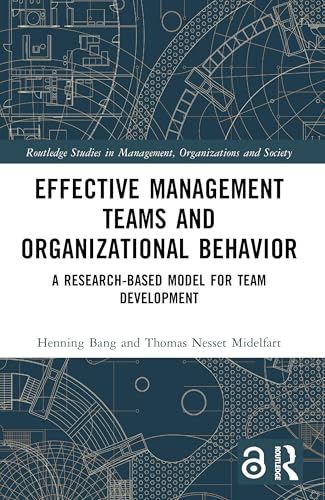
Effective management teams and organizational behavior : a research-based model for team development / Henning Bang and Thomas Nesset Midelfart.
Material type: TextSeries: Routledge studies in management, organizations and societyPublisher: New York, NY ; Abingdon, Oxon : Routledge, 2021Edition: First editionDescription: ix, 245 pages ; 23 cmContent type:
 - text
- unmediated
- volume
- 9780367513702
- 658.4022 B224e 23
- HD31.2 .B356 2021
| Item type | Current library | Shelving location | Call number | Copy number | Status | Date due | Barcode | |
|---|---|---|---|---|---|---|---|---|
 Books
Books
|
Main Library | Graduate School Library | GRD 658.4022 B224e 2021 (Browse shelf(Opens below)) | 1-1 | Available | 030105 |
Includes bibliographical references and index.
Part I. The management team -- A model for effectiveness in management teams -- The management team - a special type of team? -- Management group of management team? -- Part II. Output factors and emergent states: outcomes achieved by effective management teams -- What kind of results do effective management teams achieve? -- Part III. Input factors: basic conditions for effectiveness in management teams -- A clear team purpose -- Appropriate team tasks -- Appropriate team composition -- Supportive organizational systems -- Part IV. Processes that influence management team effectiveness -- Setting clear meeting goals -- Focused communication -- Capitalizing on diversity -- The absence of political behavior -- Team boundary spanning -- Continuous team learning -- Effective team leadership -- Part V. How can effective management teams be developed? -- Management team development - principles and dilemmas -- Tools for developing management teams.
"Most contemporary organizations use management teams to manage and coordinate their businesses at all levels of the organizational hierarchy. Management teams typically set overall goals, strategies and priorities, making vital organizational decisions. They discuss issues, solve problems, offer advice, and ensure various processes and units are aligned and interact efficiently. Although management teams are vital for overall organizational performance, research indicates they are largely underused and less effective than their potential would suggest for value creation. This book provides a research-based and practical model of the characteristics of effective management teams. It looks in depth at each factor of the model, discusses the supporting research, provides examples of how the factors influence the work and effectiveness of management teams, and shares tips and tools for successfully working with management team development. It provides researchers, academics, and students of organizational behavior with an overview of the variables that empirical research has found to be robustly related to management team effectiveness and will enable leaders and management consultants to develop more effective management teams"-- Provided by publisher.
There are no comments on this title.