
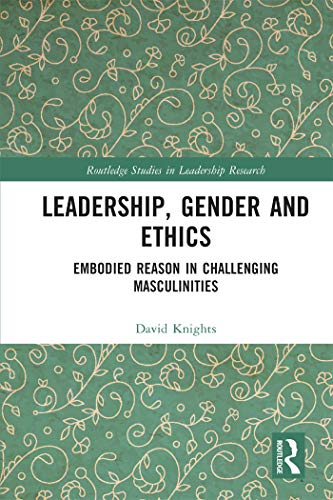
Leadership, gender and ethics : embodied reason in challenging masculinities / David Knights.
Material type: TextSeries: Routledge studies in leadership research ; 18Publisher: New York, NY ; Abingdon, Oxon : Routledge, 2021Description: x, 280 pages ; 23 cmContent type:
 - text
- unmediated
- volume
- 9780367698935
- 174.4 K748l 23
- HD57.7 .K564 2021
| Item type | Current library | Shelving location | Call number | Copy number | Status | Date due | Barcode | |
|---|---|---|---|---|---|---|---|---|
 Books
Books
|
Main Library | Graduate School Library | GRD 174.4 K748l 2021 (Browse shelf(Opens below)) | 1-1 | Available | 030097 |
Browsing Main Library shelves, Shelving location: Graduate School Library Close shelf browser (Hides shelf browser)

|

|

|

|

|

|

|
||
| GRD 174.4 B964 2020 Business ethics and care in organizations / | GRD 174.4 En86 2011 Entrepreneurship values and responsibility (volume17) | GRD 174.4 G75e 2022 Ethics and economics : an introduction to free markets, equality and happiness / | GRD 174.4 K748l 2021 Leadership, gender and ethics : embodied reason in challenging masculinities / | GRD 174.4 M472r 2020 The rise of business ethics / | GRD 174.4 R346d 2020 Disturbing business ethics : Emmanuel Levinas and the politics of organization / | GRD 174.4 W495e 2021 Ethics and business : a global introduction / |
Includes bibliographical references and index.
Introduction -- Part I. Leadership: an overview -- Reflecting on leadership studies -- Genealogies of leadership in practice and theory -- Part II. Conceptual reflections on leadership, ethics, and masculinity -- Identity and leadership -- Power/resistance -- Diversity/ gender and leadership -- Embodied reason and affective leadership -- Ethics and leadership -- Part III. Empirical illustrations of leadership, ethics and masculinity -- Academia and education -- Change, innovation and technology -- Financial sector -- Postscript: masculinities in a pandemic.
"This book has a clear concern to offer a distinctive way of studying leadership so that it might be practiced differently. It is distinctive in focusing on contemporary concerns about gender and ethics. More precisely, it examines the masculinity of leadership and how through an embodied form of reasoning, it might be challenged or disrupted. A central argument of the book is that masculine leadership elevates rationality in ways that marginalise the body and feelings and often has the effect of sanctioning unethical behaviour. In exploring this thesis, Leadership, Gender and Ethics: Embodied Reason in Challenging Masculinities provides an analysis of the comparatively neglected issues of identity/anxiety, power/resistance, diversity/gender, and the body/ masculinities surrounding the concept and practice of leadership. It also illustrates the arguments of the book by examining leadership through an empirical examination of academic life, organization change and innovation, and the global financial crisis of 2008. In a postscript, it analyses some examples of masculine leadership in the global pandemic of 2020. This book will be of interest generally to researchers, academics and students in the field of leadership and management and will be of special interest to those who seek to understand the intersections between leadership and gender, ethics and embodied approaches. It will also appeal to those who seek to develop new ways of thinking and theorizing about leadership in terms of identities and insecurities, power and masculinity, ethics and the body. Its insights might not only change studies but also practices of leadership"-- Provided by publisher.
There are no comments on this title.