
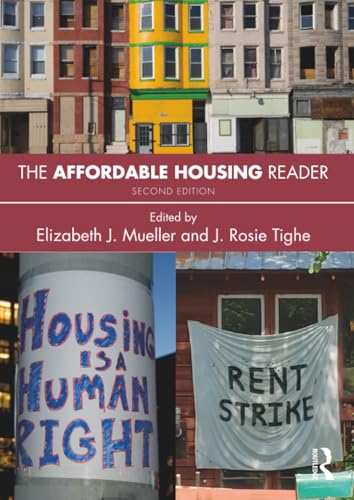
The affordable housing reader / edited by Elizabeth J. Mueller and J. Rosie Tighe.
Material type: TextPublisher: Abingdon, Oxon ; New York, NY : Routledge, 2022Edition: Second editionDescription: xxx, 538 pages ; 26 cmContent type:
 - text
- unmediated
- volume
- 9780367280475
- 363.5820973 Af28 23
- HD7287.96.U6 A38 2022
| Item type | Current library | Shelving location | Call number | Copy number | Status | Date due | Barcode | |
|---|---|---|---|---|---|---|---|---|
 Books
Books
|
Main Library | Engineering Section | ENG 363.5820973 Af28 2022 (Browse shelf(Opens below)) | 1-1 | Available | 029870 |
Revised edition of The affordable housing reader, 2013.
Includes bibliographical references and index.
Part 1. Conflicting motivations for housing policy -- A citizen's guide to public housing -- The housing act of 1948 -- The evolution of low-income housing policy, 1949 to 1999 -- The Kerner commission and housing policy -- Advancing the right to housing in the United States: using international law as a foundation -- Part 2. Defining and measuring housing problems -- What is housing affordability? The case for the residual income approach -- How do we know when housing is "affordable"? -- How affordable is HUD affordable housing? -- Consequences of segregation for children's opportunity and wellbeing -- Home is where the harm is: inadequate housing as a public health crisis -- Part 3. Housing tenures -- The grapes of rent: a history of renting in a country of owners -- The sustainability of low-income homeownership: the incidence of unexpected costs and needed repairs among low-income homebuyers -- Old wine in private equity bottles? Resurgence of contract-for-deed home sales in US urban neighborhood -- Making home more affordable: community land trusts adopting cooperative ownership models to expand affordable housing -- Part 4. Provision of affordable housing -- The quadruple bottom line and nonprofit housing organizations in the United States -- American murder mystery revisited: do housing voucher households cause crime? -- Form public housing to public-private housing -- What should be the future of low-income housing tax credit program -- Part 5. The meaning of place -- Federal support for CDCs: some of the history and =issues of community control -- W(h)ither the community in community land trusts? -- Community development corporations in the right-sizing city: remaking the CDC model of urban redevelopment -- Planning for empowerment: upending the traditional approach to planning for affordable housing in the face of gentrification -- Part 6. Planning and land use -- It's time to end single-family zoning -- Democracy in action? NIMBY as impediment to equitable affordable housing siting -- Progress for whom, toward what? Progressive politics and New York City's mandatory inclusionary housing -- One size fits none: local context and planning for the preservation of affordable housing -- Part 7. Threats to housing security -- Unaffordable America: poverty, housing, and eviction -- Metropolitan segregation and the subprime lending crisis -- Inequalities in long-term housing recovery after disasters -- Rental housing assistance and health: evidence from the survey of income and program participation -- Part 8. Race and fair housing -- Whiteness and urban planning -- The experience of racial and ethnic minorities with zoning -- Still paying the race tax? Analyzing property values in homogenous and mixed-race suburbs -- The duty to affirmatively further fair housing: a legal as well as policy imperative.
"This second edition of The Affordable Housing Reader provides context for current discussions surrounding housing policy, emphasizing the values and assumptions underlying debates over strategies for ameliorating housing problems experienced by low-income residents and communities of color. The authors highlighted in this updated volume address themes central to housing as an area of social policy and to understanding its particular meaning in the U.S. These include the long history of racial exclusion and the role that public policy has played in racializing access to decent housing and well-serviced neighborhoods; the tension between the economic and social goals of housing policy; and, the role that housing plays in various aspects of the lives of low and moderate income residents. Scholarship and the COVID-19 pandemic are raising awareness of the link between access to adequate housing and other rights and opportunities. This timely reader focuses attention on the results of past efforts and on the urgency of re-framing the conversation. It is both an exciting time to teach students about the evolution of United States' housing policy and a challenging time to discuss what policymakers or practitioners can do to effect positive change. This reader is aimed at students, professors, researchers, and professionals of housing policy, public policy, and city planning"-- Provided by publisher.
There are no comments on this title.