
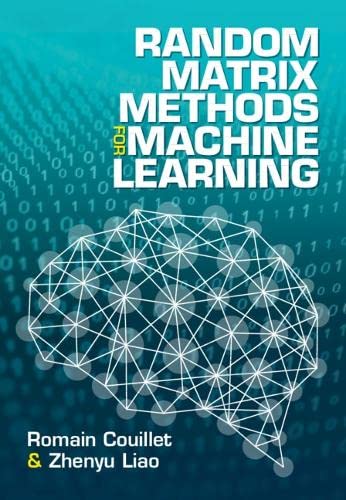
Random matrix methods for machine learning / Romain Couillet and Zhenyu Liao.
Material type: TextPublisher: Cambridge, UK ; New York, NY : Cambridge University Press, 2023Description: vii, 402 pages : illustrations ; 25 cmContent type:
 - text
- unmediated
- volume
- 9781009123235
- 006.310151922 C831r 23
- Q325.5 .C69 2023
| Item type | Current library | Shelving location | Call number | Copy number | Status | Date due | Barcode | |
|---|---|---|---|---|---|---|---|---|
 Books
Books
|
Main Library | Circulation Section | CIR 006.310151922 C831r 2023 (Browse shelf(Opens below)) | 1-1 | Available | 029350 |
Browsing Main Library shelves, Shelving location: Circulation Section Close shelf browser (Hides shelf browser)

|

|

|

|

|

|

|
||
| CIR 006.31 P317i 2022 Introduction to machine learning / | CIR 006.31 St296 2023 Statistical modeling in machine learning : concepts and applications / | CIR 006.31 T413 2021 3GE collection on computer science : social media and machine learning. | CIR 006.310151922 C831r 2023 Random matrix methods for machine learning / | CIR 006.3101519542 B341 2022 Bayesian reasoning and Gaussian processes for machine learning applications / | CIR 006.312 C276b 2021 Big data mining and complexity / | CIR 006.312 D262 2017 Data mining |
Includes bibliographical references and index.
Introduction -- Random matrix theory -- Statistical inference in linear models -- Kernel methods -- Large neural networks -- Large-dimensional convex optimization -- Community detection on graphs -- Universality and real data.
"Numerous and large dimensional data is now a default setting in modern machine learning (ML). Standard ML algorithms, starting with kernel methods such as support vector machines and graph-based methods like the PageRank algorithm, were however initially designed out of small dimensional intuitions and tend to misbehave, if not completely collapse, when dealing with real-world large datasets. Random matrix theory has recently developed a broad spectrum of tools to help understand this new curse of dimensionality, to help repair or completely recreate the sub-optimal algorithms, and most importantly to provide new intuitions to deal with modern data mining"-- Provided by publisher.
There are no comments on this title.