
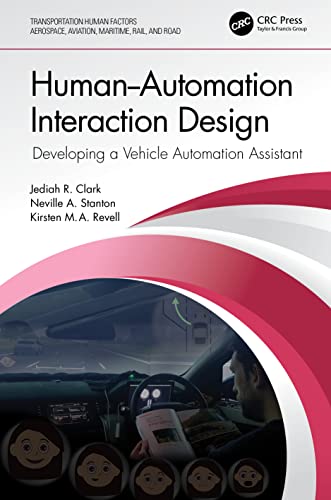
Human-automation interaction design : developing a vehicle automation assistant / Jediah R. Clark, Neville A. Stanton, and Kirsten M.A. Revell.
Material type: TextSeries: Transportation human factors: aerospace, aviation, maritime, rail, and road seriesPublisher: Boca Raton, FL ; Abingdon, Oxon : CRC Press, 2022Edition: First editionDescription: xvi, 194 pages : illustrations ; 24 cmContent type:
 - text
- unmediated
- volume
- 9781032101613
- 629.046 C547h 23
- TL152.8 .C53 2022
| Item type | Current library | Shelving location | Call number | Copy number | Status | Date due | Barcode | |
|---|---|---|---|---|---|---|---|---|
 Books
Books
|
Main Library | Engineering Section | ENG 629.046 C547h 2022 (Browse shelf(Opens below)) | 1-1 | Available | 029293 |
Includes bibliographical references and index.
Introduction -- Section I. Scoping the issues and solutions that other domains face with task continuity -- Vehicle automation as a copilot: setting the scene for effective human-automation collaboration -- Cognitive work analysis to improve communication in AV interactions -- Review of handover tools and techniques in high-risk shift-work domains -- Section II. Pilot testing these concepts in automated driving -- Replicating human-human communication in a vehicle: a simulation study -- Directability and eye-gaze: exploring interactions between vocal cues and the use of visual displays -- Section III. Designing new interfaces and interactions for automated vehicle communication -- Participatory workshops for designing interactions in automated vehicles -- Designing automated vehicle interactions using design with intent -- Section IV. Testing and validating a novel prototype -- Validation and testing of final interaction design concepts for automated vehicles -- Conclusions.
"This text presents a four-step approach for applying communicative concepts to driving automation, including: scoping, piloting, designing, and testing. It further provides experimental data on how practical human-human communication strategies can be applied to interaction in automated vehicles. The book explores the role of communication and the nature of situation awareness in automated vehicles to ensure safe and usable automated vehicle operation. It covers the issue of interaction in automated vehicles by providing insight into communicative concepts, the transfer of control in human-teams, and how these concepts can be applied in automated vehicles. The theoretical framework is built on by presenting experimental findings, design workshop output and providing a demonstration of prototype generation for automated assistants that addresses a wide range of performance outcomes within human-machine interaction. Aimed at professionals, graduate students, and academic researchers in the fields of ergonomics, automotive engineering, transportation engineering, and human factors, this text: Discusses experimental findings on how practical human-human communication strategies can be applied to interaction in automated vehicles. Provides a four-step approach for applying communicative concepts to driving automation, including: scoping, piloting, designing and testing. Explores the role of distributed situation awareness in automated vehicles. Covers communication and system awareness in response to multiple complex road scenarios. Provides design guidelines for automation-human handover design."
There are no comments on this title.