
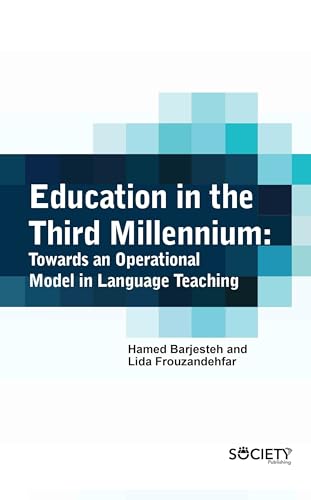
Education in the third millennium : towards an operational model in language teaching / Hamed Barjesteh and Lida Frouzandehfar.
Material type: TextPublisher: Burlington, Ontario : Society Publishing, 2022Description: xx, 222 pages ; color illustrations ; 24 cmContent type:
 - text
- unmediated
- volume
- 9781774691571
- 418.0071 B239e
| Item type | Current library | Shelving location | Call number | Copy number | Status | Date due | Barcode | |
|---|---|---|---|---|---|---|---|---|
 Books
Books
|
Main Library | Circulation Section | CIR 418.0071 B239e 2022 (Browse shelf(Opens below)) | 1-2 | Available | 029120 | ||
|
Books
|
Main Library | Circulation Section | CIR 418.0071 B239e 2022 (Browse shelf(Opens below)) | 2-2 | Available | 030497 |
Browsing Main Library shelves, Shelving location: Circulation Section Close shelf browser (Hides shelf browser)

|

|
|

|
|
No cover image available |

|
||
| CIR 418 M317c 2024 Commonly used research key terms in applied linguistics / | CIR 418.0071 B151t 2020 Teaching listening and speaking in second and foreign language contexts / | CIR 418.0071 B151t 2020 Teaching listening and speaking in second and foreign language contexts / | CIR 418.0071 B239e 2022 Education in the third millennium : towards an operational model in language teaching / | CIR 418.0071 B239e 2022 Education in the third millennium : towards an operational model in language teaching / | CIR 418.0071 C771s 2016 Second language learning and language teaching | CIR 418.0071 H191 2011 The handbook of language teaching |
Includes bibliographical references and index.
Part I: Critical approaches to pedagogy -- Political dimension of language teaching -- Critical language pedagogy -- Critical pedagogy in a classroom context -- The critical issues in materials development: hidden curriculum -- Dialogic driven pedagogy: Bakhtinian's carnival -- Critical thinking: towards an operational conceptualization -- Part II: Practical conceptualization of critical language pedagogy -- Towards postulating a dialogic model in the classroom: practical conceptualization.
"The general dissatisfaction with the efficiency of the mainstream English language teaching (ELT) in teaching English as a foreign China, Egypt, Korea, Iran, Japan, Russia, to name but a few)and at different national and international conferences and symposiums. The main dissatisfaction concerns the centralized, top-down educational management and policy. Most of the teaching models and materials fail to meet the needs of learners. Notably, they do not provide a linkage between the content and the real-life concerns (i.e., society) of learners. Thus, this dissatisfaction gives rise to adopt different internationally marketed materials in the classroom. The problem emerges due to the fact that internationally marketed materials disseminate western cultural values by providing a utopian environment to the learners. Accordingly, the need is felt to accommodate ELT materials in the EFL classrooms in the TEFL contexts to serve the local needs. With the development of critical approaches in education and their application to the field of ELT and the hidden curriculum (HC), the local perspectives towards the ELT industry in the world are emerging worldwide. Considering the notion that ELT has been regarded as a political activity, it is crystal transparent that language policymakers should not contemplate ELT as a value-free or a mere educational concern. Notably, they should approach education, in general, and teaching methods as well as materials development, in particular, from the sociocultural and sociopolitical dimension. These perspectives realize the notion of a hidden aspect in education. This aspect is the hidden curriculum and value that is inherent in any educational material. Probably, one approach to meet such a demand for domesticating ELT and helping students think about their learning can be critical thinking (CT) and critical language pedagogy (CLP) with a hope to transform the knowledge in the real-world situation.
This book intends to provide a transformative effect on learners by changing their attitudes through looking at their social problems and real-life concern of the learners. More precisely, the book aims to propose the application of critical language pedagogy in ELT classrooms and to provide practical guidelines/principles for implementing such an approach. In so doing, this book looks at education in the third millennium and proposes an operational model in language teaching. Above all, the book has been arranged in two parts. Part I encompasses six chapters dealing with the political dimension of language teaching, dialogic teaching, critical thinking, and critical language pedagogy from a theoretical and operational perspective, and the critical issues in materials development. Specifically, this section provides an overview of critical approaches to pedagogy, current and future trending ELT, origin and historical perspective of critical pedagogical thought, syllabus design, materials preparation, developing counter-hegemonic materials, assessment, and grading in critical approaches to language teaching. Section II provides a practical conceptualization of critical language pedagogy. This part deals with postulating a dialogical model with the hoe of implementing it in the classroom. This model provides transformative-based instruction. It comes into three parts, including format and presentation, content, and sequencing, monitoring, and assessment. This model can shed light on making a dynamic classroom and provides a springboard to implement dialogic teaching. As a note of caution, we would like to notify you that developing and Accordingly, teachers should plan for the risks it involves, since the proponent of transformative materials developers fly in the face of priorities of the status quo. The lack of interest of centralized institutions, the banking background of teachers, and students in transformative innovations might interfere with the dynamicity of the curse." -- Back cover
There are no comments on this title.