
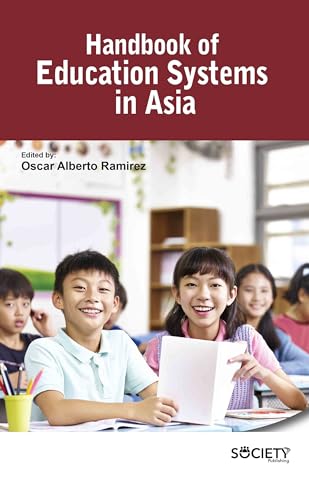
Handbook of education systems in Asia / edited by Oscar Alberto Ramirez.
Material type: TextPublisher: Burlington, Ontario : Society Publishing, 2022Description: xx, 262 pages : color illustrations ; 24 cmContent type:
 - text
- unmediated
- volume
- 9781774691106
- 370.95 H191
| Item type | Current library | Shelving location | Call number | Copy number | Status | Date due | Barcode | |
|---|---|---|---|---|---|---|---|---|
 Books
Books
|
Main Library | Circulation Section | CIR 370.95 H191 2022 (Browse shelf(Opens below)) | 1-2 | Available | 029115 | ||
|
Books
|
Main Library | Circulation Section | CIR 370.95 H191 2022 (Browse shelf(Opens below)) | 2-2 | Available | 030503 |
Browsing Main Library shelves, Shelving location: Circulation Section Close shelf browser (Hides shelf browser)

|

|

|
|

|

|
|
||
| CIR 370.78 S643m 2012 Methodology of educational research | CIR 370.7805 B119e 2019 Educational research | CIR 370.95 H191 2022 Handbook of education systems in Asia / | CIR 370.95 H191 2022 Handbook of education systems in Asia / | CIR 370.973 O743f 2014 Foundations of education | CIR 370.973 Or63f 2017 Foundations of education | CIR 370.973 Or63f 2017 Foundations of education |
Includes bibliographical references and index.
Early childhood education in Asia -- Primary school education in Asia -- Secondary school education in Asia -- Tertiary education in Asia -- Open and distance education in Asia -- Education development in Asia -- Costs and financing education in Asia -- Challenges in education in Asian countries -- Educational transformation and ICT in Asia -- School reforms and democracy in Asia -- Education trends in Asia -- The future of education in Asia.
"Education is the best tool to escape poverty and the realization of goals. Educating young people to read and write can improve their employment opportunities, plus they can be better adjusted to their national development goals-all of which rely on the dissemination of information to achieve fruitful results. This volume presents education literacy as a necessary tool for progress, which provides a new impetus to increase the enrollment rate of children, especially in Asia and the Pacific. Asia is a perfect example of expanding school enrollment; however, the region faces huge obstacles in developing a first-class education system.
Asia is a good example of how to overcome adversity by educating children. The numbers may vary from one country to another, but generally today, 9 out of 10 young people in the region are enrolled in elementary school. For a region with 66% of the globe's out-of-school kids in the 1970s, this progress is amazing.
Although much progress has occurred over the past decade, indicators still show a serious shortage of education and human resources at various levels throughout the region. This reality may weaken Asia's high economic aspirations. Experts say that in today's globalized job environment, competition comes both locally and internationally. Classrooms must attend to a changing job market, and in many countries, classrooms require more and more expertise based on technology and information technology. For Asian countries seeking to accelerate growth, people with higher skill levels are crucial. Education and training will be at the core of sustaining economic growth and the strength of the Asian economy. Elementary school is the first foundation of any education system: higher levels of success depend on the quality of the foundation. By the end of this century, the Asian community began to promote universal primary school enrollment in order to drastically reduce the illiteracy rate. Much depends on how education systems can handle and respond to changes.
In particular, South Asia has seen a large group of people under the age of 25 seeking education to face the countries, from elementary school to middle school and higher education, the governments are not keeping pace with the times. A shortage of education directly translates into a shortage of skilled workers, which may put the growth prospects of countries in danger.
Although Asia is a dynamic economy with high demand for skilled labor, compared with other developing regions, the region is also facing a widening gap between education output and labor market demand. Due to the rapid development of the labor market, more resources and innovations are needed to improve the quality of education at all levels to meet the needs of labor. Asian countries must examine the education continuum, and determine how to implement all-inclusive reforms that address the challenges they face." -- Back cover
There are no comments on this title.